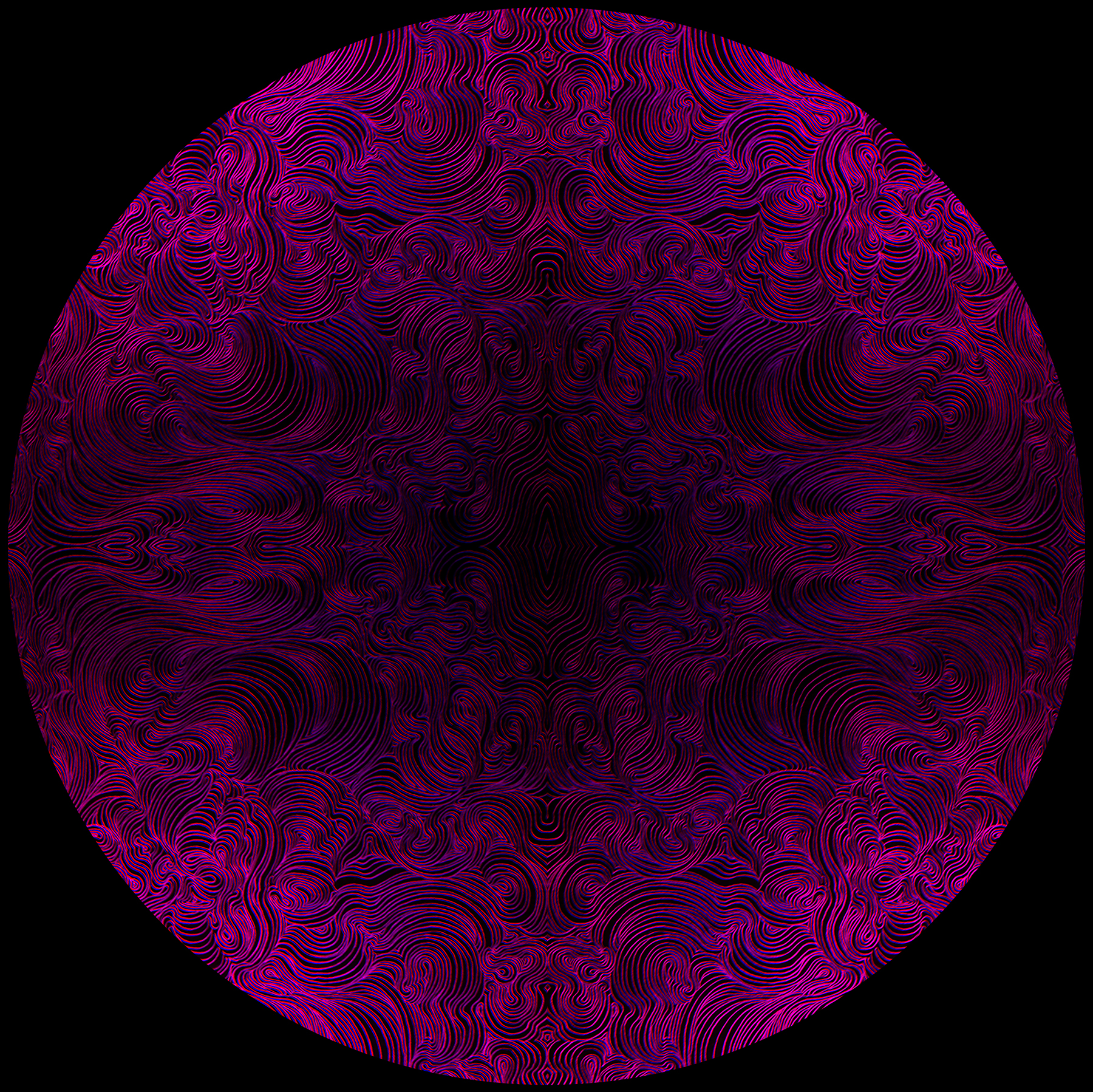
Time Crystals Rippling Over the Magenta Ocean
Time Crystals Rippling Over the Magenta Ocean is a light‑projection work composed for La Monte Young’s New Version of Chronos Kristalla for String Octet with Marian Zazeela’s Dream Light at the Bourse de Commerce in Paris.
The macrostructural image of the projection—unchanging throughout the piece—is my pencil drawing Composition 2016 No. 1, photographed under a specific angle of light so that the thin graphite lines reflect maximally. The image was then digitally separated into red and blue channels, offset by just a few pixels to produce magenta as a resultant tone. Magenta does not correspond to any single wavelength in the visible spectrum, which exists only as a perceptual construct created by the visual system’s synthesis of red and blue in the relative absence of green. In this sense, magenta behaves analogously to an acoustic “combination tone,” emerging from the interaction of two distinct frequencies.
The underlying element of the projection image—the microstructural movement of the millions of particles in the video—draws on the concept of time crystals, a newly discovered nonequilibrium phase of matter in quantum physics. This granular oscillation suggests a quantum world in which order and motion coexist, visualizing a field of particles that appear to shimmer between stability and flux. The visual texture thus mirrors the layered harmonics and extended durations of Chronos Kristalla, articulating time not as a static continuum but as a denselyoscillating probability lattice of particles, in which spontaneous configurations continually crystallize and dissolve.
Time crystals were first proposed in 2012 by Nobel laureate Frank Wilczek as a phase of matter whose lowest‑energy state is not static but exhibits spontaneous, periodic motion in time, which arise from the breaking of time-translation symmetry. Unlike conventional crystals, which break spatial translation symmetry through repeating patterns in space, time crystals break time‑translation symmetry by oscillating between configurations without consuming energy, even in their ground state. These systems therefore embody a paradoxical combination of persistent stability and continuous transformation, maintaining internal order while perpetually shifting in time.
Time Crystals Rippling Over the Magenta Ocean is conceptually grounded in this paradox of simultaneous constancy and change. The work evokes the phenomenon of broken time‑translation symmetry through image sequences that continually ripple and oscillate yet remain bound to the fixed macrostructure of Composition 2016 No 1. Just as time crystals repeat in time without dissipating energy, the projection’s motion unfolds as a cyclical, non‑exhaustive process, suggesting an ever‑renewed present dimension rather than linear progression. The visual oscillations become a metaphor for an organized non‑equilibrium, in which apparent disorder plays a constructive role in stabilizing a larger cosmic order.
The concept of time crystals entered physics more than two decades after La Monte Young composed Chronos Kristalla, whose title itself already links time and crystallization. Young has described the work as an image of time —an evolution from continuous temporal flow into a state of apparent solidity and stillness, articulated through just‑intonation tunings and pure, crystalline harmonics. Time Crystals Rippling Over the Magenta Ocean responds to and extends this idea by imagining time at a microstructural quantum scale: the projection translates the composition’s harmonic stasis and slow transformation into an optical field where stability and motion interpenetrate, adding a new visual dimension to the listener’s experience of Young’s temporal architecture.
© Jung Hee Choi 2026