April 29 to November 29, 2026
Leeum Museum of Art
60-16, Itaewon-ro 55-gil, Yongsan-gu, Seoul, 04348, Korea
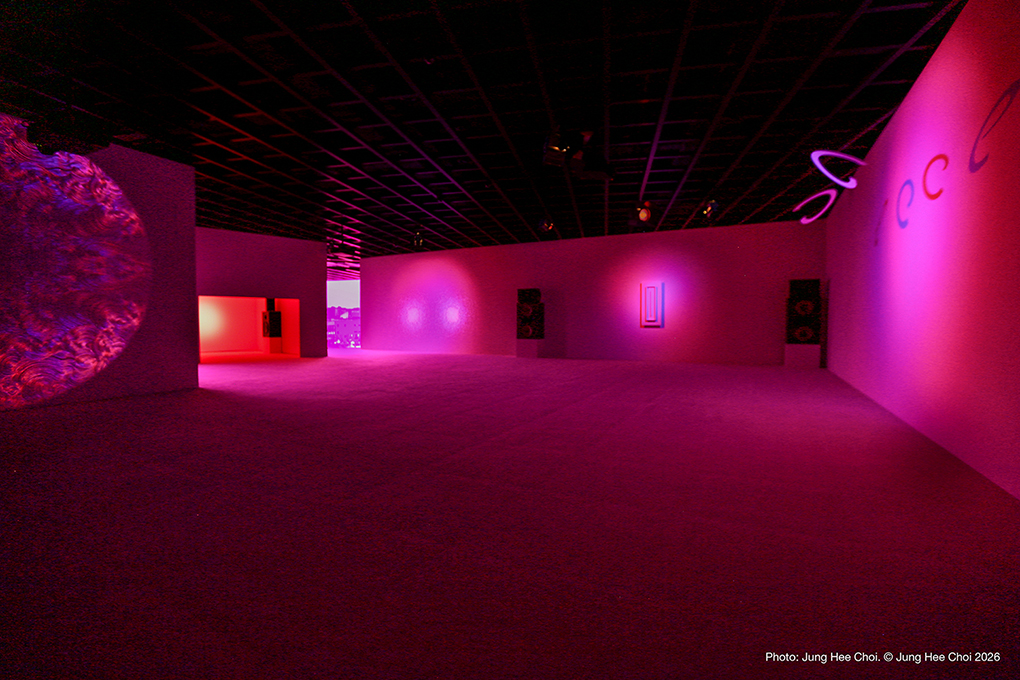
A collaborative Sound and Light Environment by La Monte Young, Marian Zazeela, and Jung Hee Choi will be presented at Leeum Museum of Art, Seoul. The Korean premiere of the Dream House, which is also the first Dream House installation ever presented in Asia, titled La Monte Young, Marian Zazeela, Jung Hee Choi Leeum 26 IV 29 Seoul Dream House, opens Thursday, April 30, 2026, and will remain on view through Sunday, November 29, 2026.
This version of the Dream House will feature the Young and Choi collaborative simultaneous sound environment presented within the Zazeela and Choi site-specific simultaneous light environment. The artists stated:
Dream House is a collaborative Sound and Light Environment, representing an original art genre and concept.
Much of our work has focused on the relationship of the media to time, or on time directly. Time is so important to the experiencing and understanding of this work that Dream House exhibitions have been specifically structured to give visitors the opportunity to spend long intervals within the environment and to return perhaps several times over the span of its duration.
By 1962, La Monte Young and Marian Zazeela had formulated the concept of a Dream House in which a work would be played continuously and ultimately exist in time as a living organism with a life and tradition of its own.
Since 2009, their senior disciple, Jung Hee Choi, has contributed to this concept through projects that manifest opposing paradigms in complementarity, merging with the works of Young and Zazeela. This collaboration creates a dialogue of interrelated frequencies in sound and light, resulting in a profound harmonicity between their complementary structures.
Building on the foundational principles established by Young and Zazeela in the 1960s and integrating Choi’s work, more than forty Dream House installations have been presented worldwide, running continuously for durations ranging from one week to thirty-two years.
Each Dream House is uniquely designed based on the architectural structure of the exhibition site, making every sound and light environment a distinct work with its own shape and dimensions. This version of Dream House incorporates the new configuration of the Young and Choi simultaneous sound environment with the Zazeela and Choi simultaneous light environment, demonstrating the ongoing evolution of Dream House, a work with the capacity to propel itself by its own momentum.
For the Leeum 26 IV 29 Seoul Dream House, we are presenting for the first time the La Monte Young The Base 9:7:4 Symmetry in Prime Time When Centered above and below The Lowest Term Primes in The Range 288 to 224 with The Addition of 279 and 261 in Which The Half of The Symmetric Division Mapped above and Including 288 Consists of The Powers of 2 Multiplied by The Primes within The Ranges of 144 to 128, 72 to 64 and 36 to 32 Which Are Symmetrical to Those Primes in Lowest Terms in The Half of The Symmetric Division Mapped below and Including 224 within The Ranges 126 to 112, 63 to 56 and 31.5 to 28 with The Addition of 119 (1991 – 1993) and the Jung Hee Choi Tonecycle for Blues Base 30 Hz, 2:3:7 with 4:3 and 7:6 Linear Superposition Of 108 x 2 Sine Wave Frequencies Set in Ratios Based on the Harmonics 2, 3 and 7 with 4:3 and 7:6 Imperceptibly Ascending Toward Fixed Frequencies and Then Descending Toward the Starting Frequencies, Infinitely Revolving as in Circles, in Parallel and Various Rates of Similar Motion to Create Continuous Slow Phase Shift with Long Beat Cycles (2016, 2026), sound environments in simultaneity. For the Leeum 26 IV 29 Seoul Dream House, the frequency relationships in both Young’s and Choi’s sound environments evolve from the same 30 Hz base to create a profound harmonicity in their complementary structures.
“The Base 9:7:4 Symmetry” and “Tonecycle” sound environment is another example of a Young and Choi collaborative sound work projecting the opposite paradigms in complementarity, where two sound environments will be simultaneous and harmonizing in one acoustic space, allowing the listener to experience the complex interrelationship of these two sets of intervallic frequency ratios. The sine waves in Young’s The Base 9:7:4 Symmetry consist of long-sustained tones that remain constant and sound eternally without any change. In her writing, Choi articulates the opposing natures of the two sound environments. She explains:
Young’s sound environment in the Dream House contains complex intervallic ratios of continuous sine waves that would theoretically sound eternally, without any aspiration toward melody or rhythm. The long, sustained tones are locked and remain constant, projecting a sense of eternal stasis. However, even the smallest and unavoidable actions of the listener, such as breathing or blinking, change the perception of the tones. With the human body, the audience can never fully experience the absolute constancy of the work. In contrast, the sine wave frequencies in my sound environment, Tonecycle Base 30 Hz, 2:3:7, are constantly revolving and never stand in any one place long enough to satisfy the definition of a traditional musical pitch. The motion of the tones is extremely slow and, therefore, the sense of pitch shift is practically imperceptible. Yet because the tones move at a constant speed in the same direction and the relationships among corresponding frequencies remain relativistically invariant, they create the aural illusion that the frequencies of the tones remain unchanged. Over time, the interactions of these slow-moving sine waves give rise to the gradual emergence of distinctive melodic and rhythmic patterns, produced not by thematic development but by the acoustic phenomenon of phase interference. By presenting my imperceptibly yet continuously moving frequencies together with Young’s fixed frequency constant, it becomes possible for the listener to perceive the movement of my frequencies in time.
In the light environment, Zazeela presents four works: animated calligraphy, Imagic Light (1993), Ruine Window from Still Light (1992) and environment, Magenta Day / Magenta Night, Leeum (1993, 2026), and Neon, Dream House Variation II (1990). Together with Zazeela, Choi presents three light installation works: RICE in the Magenta Field (1999, 2021) 108 x 2 Sine Wave Matrix (G/R) for Tonecycle for Blues Base 30 Hz, 2:3:7 with 4:3 and 7:6 (2016, 2026), and Time Crystals (2026).
View the full MELA Press Release here